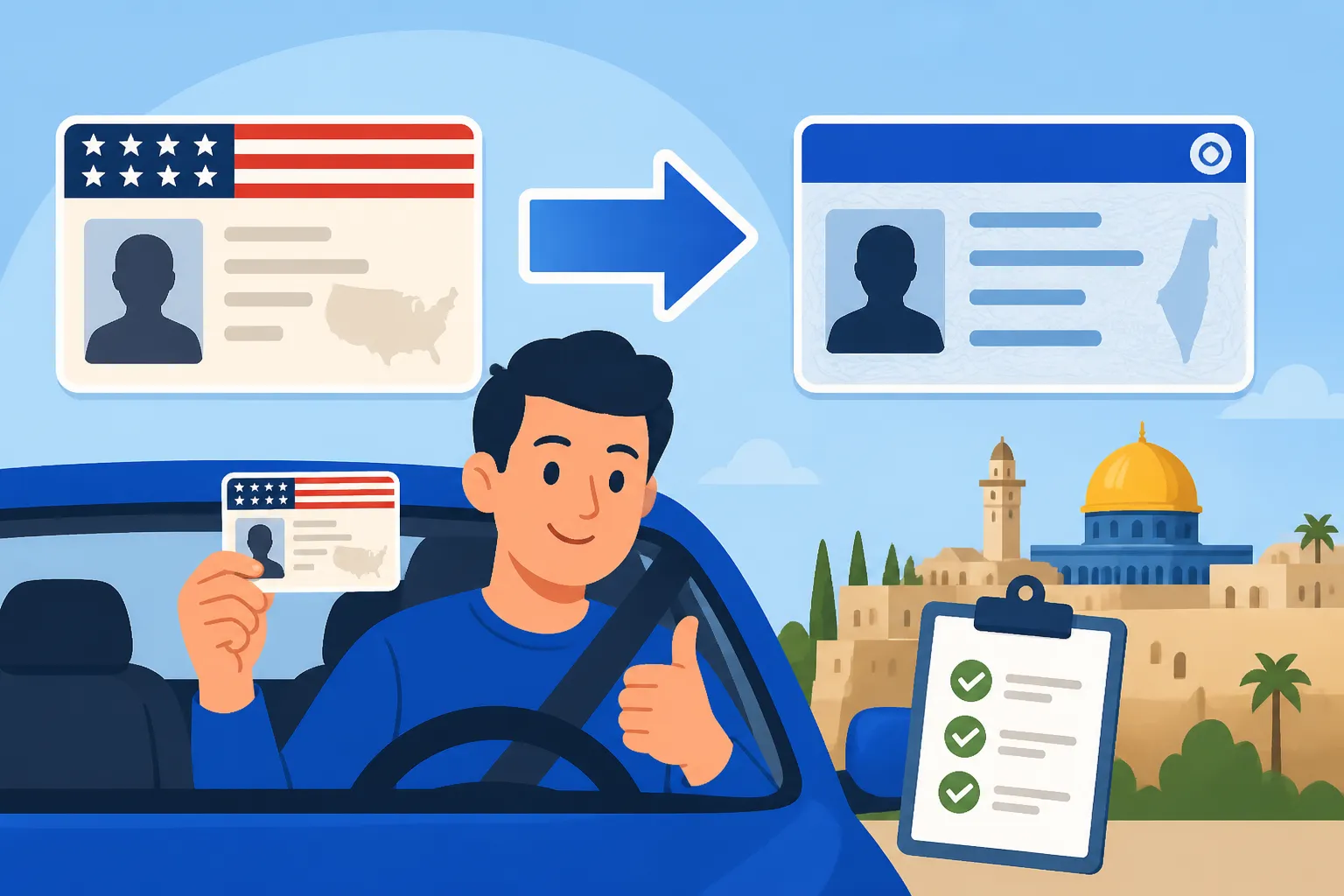
How Do I Convert My US Driving Licence in Israel?
Moving to Israel is an adventure, but let’s be honest, it often feels like a crash course in bureaucracy, especially when it comes to something as vital as driving. You’ve got your US driver's license, you’re ready to hit the roads, but suddenly you’re faced with a maze of forms, tests, and waiting periods. This guide is here to cut through the confusion and walk you through every single step of converting your US driving license to an Israeli one, making sure you understand the nuances and pitfalls along the way.
The Initial Hurdles: Understanding the Israeli Driving System for Expats
When you first arrive in Israel, especially after a long journey (perhaps you used a service like Sirelo to help with your move), the last thing you want to think about is more paperwork. But getting your driving situation sorted is crucial. It’s not just about convenience; it’s about legality and peace of mind.
Why Conversion, Not Just an International Permit?
This is a common question, and it's a valid one! Many expats arrive thinking their existing US driver's license, perhaps supplemented by an International Driving Permit (IDP), will be enough. And for a short while, it can be. However, there are significant limitations you need to be aware of, especially if you plan on making Israel your long-term home.
Firstly, your foreign driving license is generally only valid in Israel for a period of one year from the date of your Aliyah (for new immigrants) or your first entry as a resident. If you’re here on a different type of visa, like a B/1 work visa, the rules can vary slightly, but the general principle of a limited validity period for your foreign license holds true. After that year, your US license effectively becomes invalid for driving in Israel. That means if you get pulled over, you could be cited for driving without a valid license, which is a serious offense. An International Driving Permit merely translates your existing license; it doesn't extend its validity in Israel past that initial year. It's a useful document to have in your pocket, especially during that initial period, as it makes things clearer for traffic police, but it's not a substitute for an Israeli license. Relying solely on your US license past that one-year mark is essentially risking fines, legal troubles, and potentially issues with your insurance coverage if you're involved in an accident. You definitely don’t want to be caught in that situation! It's much less stressful to plan for the conversion, rather than scrambling at the last minute. For a broader look at driving regulations, check out our guide on Driving in Israel: Licences, Registration and Rules for Expats (2027).
Key Terminology and Agencies You'll Encounter
Navigating any bureaucratic system in a new country means learning new terms and understanding which offices handle what. Israel is no different. The main agency you'll be dealing with for anything driving-related is the Ministry of Transport, locally known as the "Misrad HaRishui" (משרד הרישוי). This is Israel's equivalent of the DMV in the United States. They are the gatekeepers for all things licenses, vehicle registration, and road safety.
You might also hear about the "Makhon Refu'i" (מכון רפואי), which is the Medical Institute for Road Safety. This institution usually only gets involved if there are specific medical concerns flagged during your application or if you're over a certain age and need more extensive medical checks to prove you're fit to drive. For most standard conversions, you'll mainly deal with an optometrist and your general doctor for a basic medical declaration. The document you’ll ultimately receive is called a "Rishayon Nehigah" (רישיון נהיגה), which simply means "driving license." Getting your head around these terms early on will save you a lot of head-scratching later. Knowing the lingo, even just a little, can significantly smooth out your interactions with officials.
Step-by-Step: The US Driving License Conversion Process in Israel
Alright, let's get down to the nitty-gritty. The process can seem daunting, but breaking it down into manageable steps makes it a lot less intimidating. Think of it as a checklist, and you’ll tick off each item one by one.
Pre-Requisites and Gathering Your Documents
Before you even think about setting foot in a Misrad HaRishui office, you need to make sure you meet the basic eligibility criteria and have all your ducks in a row document-wise. This is where most people hit their first snag, so pay close attention.
Firstly, eligibility: generally, if you're a new immigrant (Oleh Chadash), a returning resident (Toshav Chozer), or an A/1 temporary resident visa holder, you qualify for the conversion process. If you’re here on a standard work visa (like a B/1 visa), you also typically qualify. The key is that you must be recognized as a resident for a certain period. As an Oleh, your eligibility starts from your date of Aliyah. You must have held your US driving license for at least five years prior to your Aliyah date. If you've had it for less than five years, you might be required to take a full theoretical and practical test, just like a new driver in Israel. So, if you just got your US license last year, be prepared for a longer process.
Now, for the documents, and this is where it gets crucial:
- Your Valid US Driving License: This is obvious, but make sure it’s current and not expired.
- Teudat Zehut (Israeli ID Card): This is your primary form of identification in Israel. If you’ve just made Aliyah, you should have received your temporary Teudat Zehut at the airport or soon after. Without it, you won't get very far. If you still need to sort this out, our guide on How to Get a Teudat Zehut (Identity Card) in Israel can help.
- Proof of Entry/Residency: This could be your Aliyah visa, your B/1 work visa, or your passport with the entry stamp. They want to verify your status and the date your eligibility period began.
- Eye Test Form (Tofes Yarok): This used to be a physical green form, but it's increasingly digital. You'll need to fill out a medical declaration and undergo an eye exam. More on this below.
- Proof of Address: Sometimes they ask for this, like a utility bill (electricity, water, arnona) to confirm your residential address in Israel. When you first arrive, getting these things sorted can be a headache, but remember services like Airalo can at least keep you connected and help with navigation while you're getting situated and finding addresses.
The biggest frustration here is often the "one missing document" scenario. You go, you wait, you get to the front, and bam – you're missing a stamp, a signature, or a photocopy. My advice: over-prepare. Bring originals and at least two copies of everything. And if you have any doubts, call the Misrad HaRishui or ask someone who’s recently gone through the process. It's better to be overly cautious than to have to make multiple trips.
The Eye Test and Medical Declaration: Your First Stops
This is usually the easiest part of the process, thankfully. You need to get your vision checked and declare that you're medically fit to drive.
You can get an eye test at most private optical stores or optometrists across Israel. Just walk into a "Machon Optika" (מכון אופטיקה) or any optical chain like Opticana, Erroca, or Super-Pharm Optics, and tell them you need an "examination for Rishayon Nehigah" (בדיקת עיניים לרישיון נהיגה). They are very familiar with the procedure. The test itself is quite straightforward: checking your basic vision, peripheral vision, and perhaps color recognition. It usually takes less than 15-20 minutes. There's a small fee for this, typically around 50-70 NIS.
Crucially, the optometrist will also help you fill out the medical declaration form. This form asks about your general health, any pre-existing medical conditions (like diabetes, heart conditions, epilepsy, etc.), and any medications you are taking. You essentially declare that you are medically capable of driving safely. For most people, this is a simple "no" to all the serious questions. However, if you answer "yes" to certain conditions, you might be referred to a general practitioner for further evaluation, or even to the more specialized Makhon Refu'i. Don't try to hide anything, as it could have serious legal repercussions down the line. Once the optometrist completes their part, they will often electronically send the information to the Misrad HaRishui, or give you a printout (the "Tofes Yarok" if it's still a physical form) which will have their stamp and signature.
Getting Your "Tofes Yarok" (Green Form) and Misrad HaRishui Visit
The "Tofes Yarok," or Green Form, is legendary among those who have gone through the Israeli driving license process. Historically, it was a physical green multi-part form that you had to shepherd through various stages. Nowadays, much of this has been digitized, which is a blessing, but the concept remains the same: it's the official application and medical/eye test record.
After your eye test and medical declaration are complete (and potentially signed off by a doctor if needed), the next step is to get this information formally submitted to the Misrad HaRishui. Sometimes, the optometrist will submit it digitally. Other times, you'll need to take the printed form, complete with your photo, to a Misrad HaRishui office.
Booking an Appointment: This is vital. You almost never just walk into a Misrad HaRishui office in Israel and expect to be seen quickly, if at all. You must book an appointment in advance. This can usually be done through the national government website (gov.il) or via the 'My Visit' (MyVisit) app. Search for "Misrad HaRishui" and book a slot for "המרת רישיון נהיגה" (Hamarat Rishayon Nehigah – Driving License Conversion). Be prepared for limited slots, especially in major cities like Tel Aviv or Jerusalem, so book as soon as you have your other documents ready. For those navigating the entire Aliyah process, remember that registering your address with the Registering Your Address with the Population Authority in Israel is a key step, as the Misrad HaRishui will cross-reference your details.
At the Misrad HaRishui: When your appointment day arrives, bring all your documents: original US license, Teudat Zehut, passport, proof of entry, and any printed forms from your eye test. You'll typically take a number (even with an appointment, though sometimes there's a dedicated line), wait, and then present your documents to a clerk. They will verify everything, take your photograph for the Israeli license, and capture your biometric data (fingerprints). This is where having an English-speaking clerk can be a huge relief, but don't count on it. Be patient, smile, and use simple Hebrew or a translation app if needed. The clerk will confirm your eligibility for a "mini test" (if you've had your US license for 5+ years) or a full test (if less than 5 years). They will then issue you a temporary paper license, valid for six months, which permits you to drive under supervision while you prepare for your driving test.
The Driving Test: It's Not as Scary as It Sounds (Usually)
Okay, the phrase "driving test" probably makes your heart beat a little faster, even if you’ve been driving for years. The good news for US license holders converting their license in Israel is that it’s generally not the full, intimidating test a brand-new driver faces.
Understanding the "Mini Test" (Test Minimale)
For those who have held their US driving license for at least five years prior to their Aliyah date, you are typically eligible for what is colloquially known as a "mini test" (מבחן מינימלי) or a conversion test. This is significantly shorter and less stressful than the full practical test required for new drivers. The purpose of this test isn't to re-evaluate your fundamental driving ability, but rather to ensure you understand and adhere to Israeli traffic laws, road signs, and driving etiquette.
What does it involve? You'll typically drive with an authorized Israeli driving instructor, who also acts as the examiner. The test usually lasts about 15-20 minutes. They will observe your driving in various situations:
- Basic Maneuvers: Parking (often parallel parking or backing into a space), turning, lane changes.
- Road Signs and Rules: Demonstrating knowledge of Israeli road signs (which are often pictograms and can be different from US signs) and adhering to local traffic laws (e.g., yielding to pedestrians, understanding right-of-way at intersections, roundabouts).
- Awareness: Your ability to observe your surroundings, use mirrors, and anticipate other drivers.
- General Flow of Traffic: How smoothly you integrate with local traffic conditions.
The instructor isn't looking for perfection, but rather competence and adherence to Israeli norms. They know you're an experienced driver; they just need to ensure you can adapt to the Israeli driving environment. It’s certainly less nerve-wracking than the full test, but it still requires some preparation.
Booking Your Test and What to Bring
This part involves finding an instructor, which is fairly straightforward. You need to find a licensed driving instructor ("Moreh Nehigah" – מורה נהיגה) who is authorized to administer these conversion tests. You can ask for recommendations from other expats or search online. Many instructors speak English, especially in areas with large expat populations like Tel Aviv, Jerusalem, or Ra'anana.
Booking the Test: Once you find an instructor, you'll coordinate with them to schedule the "mini test." They will use their vehicle for the test. It's highly recommended to take at least one or two preparatory lessons with them before the actual test. This is crucial for several reasons:
- Familiarity with the Vehicle: Israeli cars might be different from what you're used to, especially if you drive an automatic in the US and they use a manual, though automatics are very common now.
- Local Rules and Habits: The instructor can highlight specific Israeli driving habits, common mistakes made by foreigners, and specific road signs you need to know. For instance, the infamous Israeli roundabouts can be tricky for newcomers.
- Route Practice: They often take you on routes similar to what you'll encounter during the test, so you're familiar with the area.
- Language: Having an instructor who can calmly explain things in English (or your preferred language) during the test itself can reduce anxiety.
What to Bring on Test Day:
- Your temporary paper driving license (the one issued by Misrad HaRishui).
- Your valid US driving license.
- Your Teudat Zehut.
- Payment for the instructor and the test fee (your instructor will advise on this).
Tips for Success:
- Learn the Signs: Spend some time familiarizing yourself with Israeli road signs. Many are international, but some are unique.
- Practice with an Instructor: Seriously, don't skip this. Even one lesson can make a world of difference.
- Be Confident, Not Aggressive: Israeli driving can be assertive, but for the test, drive defensively and according to the rules.
- Observe Locally: Pay attention to how people drive around you in Israel. Notice things like lane discipline, parking habits, and pedestrian crossings.
Passing this test is usually a high probability if you prepare even a little bit. It's more about showing compliance and awareness than proving advanced driving skills. After passing, you’ll receive an immediate confirmation from the instructor.
Post-Test and Receiving Your Israeli License
You’ve done it! You’ve passed the mini test. The immediate relief is palpable, but there are still a couple of administrative hoops to jump through before that shiny new plastic license is in your hand.
Paying the Fees and Interim License
Once your instructor confirms you've passed the driving test, you’re essentially authorized to drive in Israel. Hooray! However, you still need to pay the official government fee for the issuance of your Israeli driving license. Your instructor will usually tell you the exact amount. As of 2024, the fee for a new driving license is typically around 200-300 NIS, but it can change, so always confirm.
You can pay this fee in a few ways:
- Online: The easiest way is usually through the Misrad HaRishui section of the government website (gov.il) or via the "Rishuy" app.
- Post Office (Doar Yisrael): You can also go to any Israel Post (Doar Yisrael) branch and pay at the counter. Make sure to bring your Teudat Zehut and your temporary paper license.
Once you’ve paid the fee, you’ll immediately receive a temporary paper license (an extension of the one you might have already had or a new one, depending on the process). This temporary license is valid for a specified period (usually up to six months) and allows you to legally drive while you wait for your permanent plastic card to be printed and mailed to you. Make sure to keep this paper document with you at all times when driving, along with your Teudat Zehut. This temporary license is your official proof that you're legal on the roads.
Waiting for Your Permanent License
Now comes the waiting game. After all the running around and testing, the final step is usually the longest: waiting for your physical, plastic Israeli driving license card to arrive in the mail.
The standard timeframe for receiving your permanent license in the mail is anywhere from two to six weeks. It largely depends on the workload of the Misrad HaRishui and the postal service. It will be mailed to the address registered on your Teudat Zehut, so make absolutely sure your address with the Population Authority (Misrad HaPnim) is up-to-date. If you moved recently, or if you're like many expats who often have their address registered somewhere else initially, this could be a point of failure. Our article on Registering Your Address with the Population Authority in Israel highlights how important it is to keep this information current.
What to do if it doesn't arrive:
- Be Patient: First, wait out the full six weeks. Israeli postal services, while generally reliable, aren’t always speedy.
- Check Online: You can often check the status of your license issuance on the gov.il website under the Misrad HaRishui section.
- Contact Misrad HaRishui: If it’s been longer than six weeks, or if the online status shows an issue, you’ll need to contact the Misrad HaRishui. This can be done via their call center (though waiting times can be long) or by booking another appointment at one of their offices. Bring your temporary paper license and Teudat Zehut to any interaction.
Once that plastic card finally lands in your mailbox, you’re officially good to go! Tuck it into your wallet, breathe a sigh of relief, and enjoy the freedom of the Israeli roads. Just remember that driving here is an experience unto itself, so always stay vigilant!
Here's a quick overview of the differences between driving on a foreign license vs. a converted one:
| Feature | Driving with US License (within 1st year of residency) | Driving with Converted Israeli License |
|---|---|---|
| Legality | Legal for 1 year from residency start date | Permanently legal as long as valid |
| Acceptance | Generally accepted by police, but can cause confusion | Universally accepted |
| Insurance Coverage | May have limitations or higher premiums | Standard Israeli insurance coverage |
| Car Rental | Possible, but rental companies may prefer local license | No issues, standard process |
| Traffic Stops | May require additional explanations | Smooth, standard procedure |
| Validity Period | Expires after 1 year | Typically valid for 10 years, then renew |
| Required Test | None initially, but international permit recommended | "Mini Test" for US license holders (5+ years experience) |
Disclaimer
The information provided in this guide is for general informational purposes only and does not constitute legal or professional advice. Driving regulations and bureaucratic procedures in Israel are subject to change. While we strive to provide accurate and up-to-date information, it is always recommended to verify the latest requirements with the official Israeli Ministry of Transport (Misrad HaRishui) or seek advice from a qualified professional before taking any action.