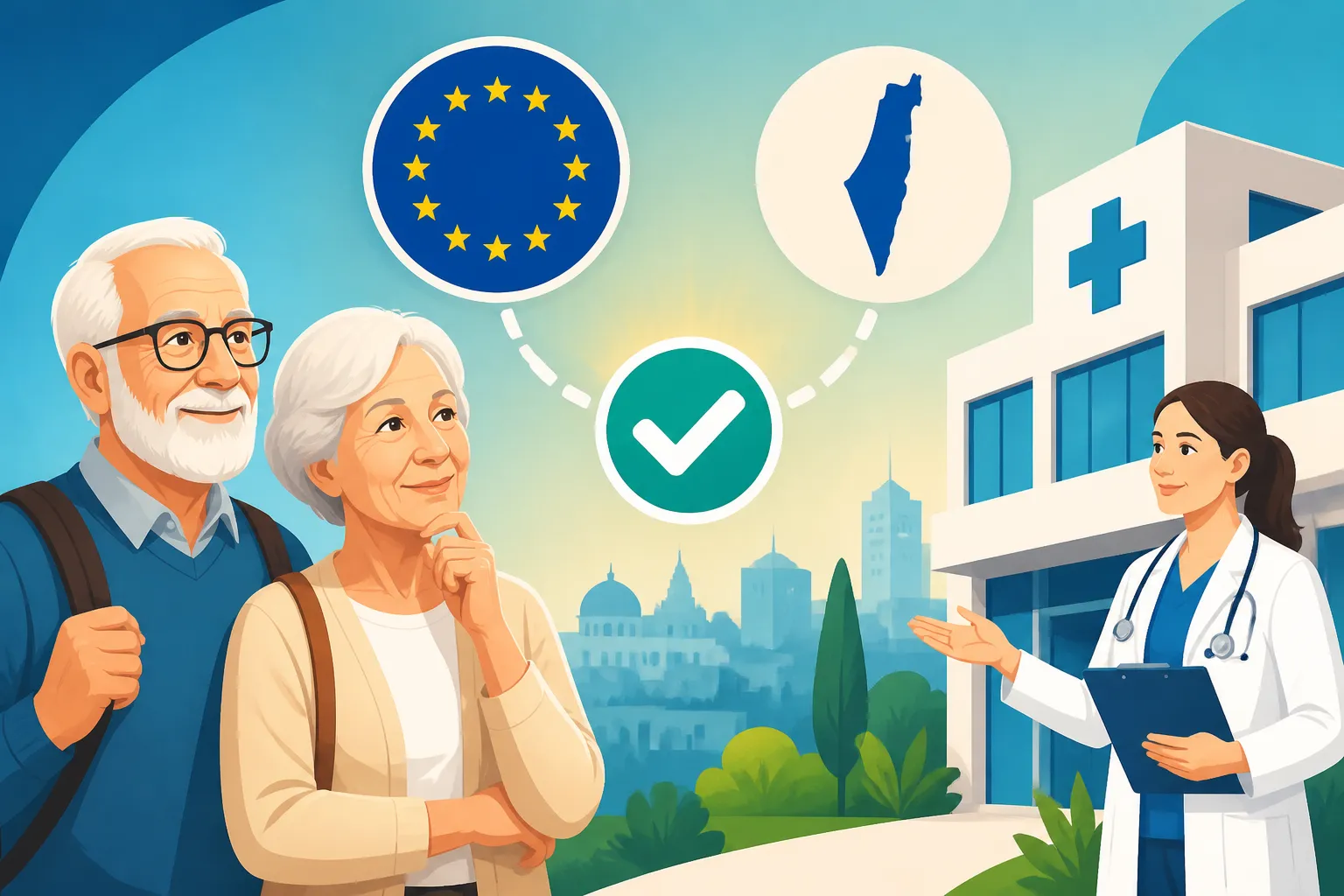
Can EU Pensioners Use Israeli Public Healthcare?
Moving to Israel as a retiree is a beautiful dream, but many EU pensioners arrive at Ben Gurion Airport under the dangerous assumption that their European Health Insurance Card or social security reciprocity will grant them immediate access to the Israeli medical system. This guide clarifies exactly why that is not the case and provides a detailed roadmap to securing health coverage without falling into expensive bureaucratic traps.
The Reality of Reciprocity: Why Your EHIC Card Does Not Work in Israel
One of the most common and stressful shocks for retirees from France, Germany, or Italy is realizing that Israel is not an extension of the European healthcare network. Back in the EU, you are likely used to the seamless transition of benefits between member states. If you move from Berlin to Madrid, your healthcare rights largely follow you. However, Israel exists entirely outside this framework. I have seen many pensioners walk into a clinic in Netanya or Ashdod, present their European health card, and be met with a polite but firm request for a credit card or a local Israeli health fund ID.
The misconception often stems from the fact that Israel does have bilateral social security agreements with several EU countries. For instance, if you worked in Germany, there are agreements regarding the payment of your pension into an Israeli bank account. But—and this is a massive distinction—these agreements almost never cover medical insurance. Medical care in Israel is governed by the National Health Insurance Law, which is strictly based on Israeli residency, not on your status as a pensioner in your home country.
Imagine a couple from Marseille who has spent forty years paying into the French system. They arrive in Tel Aviv on a Tuesday, and by Thursday, one of them needs a prescription for blood pressure medication. Without a local registration, they are viewed as tourists. This means they will pay the full, unsubsidized "private" rate for a doctor’s visit and the medication, which can be significantly higher than the co-payments they are used to in Europe. Navigating this requires understanding that The Expat Guide to National Health Insurance (Bituach Briut Mamlachti) in Israel is your new rulebook.
Understanding the Residency Hurdle for EU Pensioners
To access the public healthcare system, known as the Kupot Holim, you must first be recognized as a resident by the National Insurance Institute, or Bituach Leumi. For most EU pensioners, this happens through one of two main paths: making Aliyah (immigrating under the Law of Return) or holding an A/1 Temporary Resident visa. If you are in Israel on a standard B/2 tourist visa, even if you own property and spend six months a year here, you are legally ineligible for the public healthcare system.
The residency process is not instantaneous. After you receive your Teudat Zehut (ID card) or your residency visa, you must register with Bituach Leumi. For many, this involves proving that your "center of life" is now in Israel. This means showing lease agreements, utility bills, or evidence that you have closed your affairs back in Europe. Until Bituach Leumi confirms your residency, you cannot join a health fund. During this limbo period, having a flexible plan like SafetyWing can be a lifesaver, as it provides medical coverage for those who are between systems and haven't yet secured local residency status.
Once you are in the system, you will need to understand How Bituach Leumi Health Contributions Work in Israel. For retirees, the monthly payments are often deducted directly from your Israeli pension if you have one, or you must pay them manually via the Bituach Leumi website. The cost is generally low compared to private European insurance, but the administrative hurdle of getting "into the computer" is the part that causes the most grey hair for newcomers.
The Waiting Period: The Six-Month Gap
Even after you are recognized as a resident, there is a specific legal hurdle called the "waiting period" (Mamtana). This is a policy designed to prevent "health tourism" and ensures that people moving to Israel are truly here to stay before they utilize the heavily subsidized public system. The rule generally states that for every year you lived abroad, you must wait one month before becoming eligible for public health services, up to a maximum of six months.
For an EU pensioner who hasn't lived in Israel for decades, this almost always means a six-month wait. This is a critical period where you are a resident in name, but you have no medical safety net. You cannot simply go to a Clalit or Maccabi clinic and get a check-up. If you have a chronic condition, you must bring a six-month supply of medication from Europe or be prepared to pay private prices at an Israeli pharmacy.
During this gap, you must have private insurance. Many expats choose SafetyWing because it offers a straightforward way to cover unexpected medical emergencies without the long-term commitment of an Israeli private policy that might not even accept you yet due to age or pre-existing conditions. It is also important to read up on Understanding Health Insurance Waiting Periods for New Olim in Israel to see if you qualify for any waivers, though these are increasingly rare for retirees who are not moving under specific humanitarian circumstances.
Comparing Public and Private Options for Retirees
Once you are eligible to join a Kupah (Health Fund), you will have to choose between the four main providers: Clalit, Maccabi, Meuhedet, and Leumit. For EU pensioners, the choice often comes down to the availability of English-speaking or even French/German-speaking doctors in their specific neighborhood. Clalit is the largest and has the most clinics, while Maccabi is often praised for its digital efficiency and high concentration of specialists in urban centers like Tel Aviv and Jerusalem.
However, the public "basket of services" (Sal Briut) has limits. This is why most Israelis, and almost all expats, opt for "Bituach Mashlim" or supplementary insurance. For a small monthly fee, this gives you access to discounted dental care, second opinions from top-tier surgeons, and lower co-pays on non-essential medications. Even with this, some retirees still choose to maintain a global private policy like SafetyWing, especially if they plan to travel back to Europe frequently or want the peace of mind of being treated in private hospitals like Assuta without waiting weeks for a public hospital slot.
| Feature | Israeli Public Healthcare (Kupat Holim) | Private Supplementary (Bituach Mashlim) | International Private (e.g., SafetyWing) |
|---|---|---|---|
| Eligibility | Legal residents only | Must have Public Health first | Anyone |
| Waiting Period | Up to 6 months | None (if joined immediately) | Immediate |
| Specialist Access | 1-4 weeks average | 2-10 days average | Very fast / Private clinics |
| Primary Care | Family doctor in clinic | Same as Public | Private doctors only |
| Coverage Abroad | Very limited | Some emergency travel cover | Full global coverage |
| Medication | Heavily subsidized (Sal Briut) | Subsidized "non-basket" drugs | Reimbursed based on plan |
When looking at the numbers, you should consult The Cost of Healthcare in Israel: A Complete Breakdown for Foreigners (2026) to budget your retirement accurately. Israel is not a "cheap" country, and while healthcare is high quality, the out-of-pocket costs for things like hearing aids, high-end dental implants, or specialized home care can add up quickly.
Navigating the Pharmacy and Specialist System
For an EU pensioner, the way prescriptions work in Israel can feel like a bureaucratic maze. In many European countries, you take a paper slip to any local pharmacy. In Israel, the system is highly integrated. Your prescription is usually digital and "loaded" onto your health fund magnetic card. You must go to a pharmacy that is either owned by your Kupah or has a contract with them (like the "Beit Mirkachat" found in Super-Pharma branches).
Getting to see a specialist is another area where the culture shock hits. In the public system, you usually need a referral (Hafnaya) from your family doctor (Rofeh Mishpacha). Without this referral, the system won't even let you book an appointment with a cardiologist or a dermatologist. I always tell newcomers: find a family doctor you like and who speaks your language fluently. They are the gatekeepers to everything else. You can learn more about this process in our guide on How to Get a Referral (Hafnaya) to a Specialist in Israel.
If you find that the wait for a specialist in the public system is too long—sometimes it can be months for non-urgent matters—this is where your private insurance or your "Mashlim" tier becomes vital. For retirees, time is often of the essence, and being able to bypass a three-month wait for a specialist consultation by paying a small "Hishtatfut Atzmit" (co-payment) through your supplementary insurance is worth every shekel.
Practical Steps to Secure Your Coverage
If you are an EU pensioner planning the move, your first step should be an audit of your current health. Get all your records translated or at least summarized in English. Israeli doctors are highly skilled and most speak excellent English, but having a clear history of your treatments in Europe will save you hours of frustration.
- Secure Transition Insurance: Before you even cancel your European apartment, sign up for a plan like SafetyWing. You need coverage from the moment you land until the moment your Israeli residency is finalized.
- Register with Bituach Leumi immediately: Do not wait. As soon as you have your visa or Teudat Zehut, go to the local branch or use the online portal. Every day you delay is another day added to your potential waiting period.
- Choose your Kupah: Research which health fund has the best facilities in your new city. For example, if you are moving to Jerusalem, certain funds have much better presence in the central neighborhoods than others. Our guide on Choosing a Kupat Holim in Israel: Clalit, Maccabi, Meuhedet or Leumit (2027) can help with this decision.
- Ship your medications: Bring at least a 3-month (preferably 6-month) supply of your maintenance medications. It takes time for an Israeli doctor to "approve" your chronic status in their local system so you can get subsidized prescriptions.
For those who are used to the European Health Card at an Israeli Hospital, the transition is certainly a challenge. It requires a proactive approach to paperwork that many retirees hoped to leave behind in Europe. However, once you are settled into the Israeli system, the quality of care is world-class. The medical technology in Haifa and Tel Aviv is among the best in the world, and the community-based care provided by the Kupot Holim is surprisingly personal once you learn how to navigate the digital apps and appointment systems.
Essential Considerations for Chronic Conditions
If you are managing a chronic condition such as diabetes, heart disease, or a respiratory issue, the stakes are higher. The "Health Basket" in Israel is updated annually and is quite generous, covering many of the latest biological drugs and treatments. However, you must "prove" your condition to your new Israeli family doctor. They will not simply take your word for it or even a foreign prescription. They will likely send you for a fresh round of blood tests and possibly a local specialist consultation to confirm the diagnosis within the Israeli system.
This is another reason why the waiting period is so critical. If you have a flare-up during those first few months of residency when you aren't yet fully covered by a Kupat Holim, a trip to the Emergency Room (Miyun) can cost thousands of shekels. Having a reliable secondary option like SafetyWing ensures that these "gap months" don't result in financial ruin before your retirement in the sun has even truly begun.
Also, be aware of Supplementary and Private Health Insurance in Israel: Options Explained because many of the "premium" medications used in Europe might be available in Israel but only covered under the higher tiers of insurance. Checking the "Sal Briut" (Health Basket) list for your specific medications before you move is a high-level expat move that can save you a lot of stress later.
Important Medical Disclaimer
The information provided in this guide is for educational and informational purposes only and does not constitute legal or professional medical advice. Healthcare laws, Bituach Leumi regulations, and insurance policies in Israel are subject to frequent changes. Always consult with the official National Insurance Institute (Bituach Leumi), your chosen Kupat Holim, or a qualified legal professional to confirm your specific eligibility and requirements. Neither the author nor this website assumes any liability for actions taken based on the information provided herein.