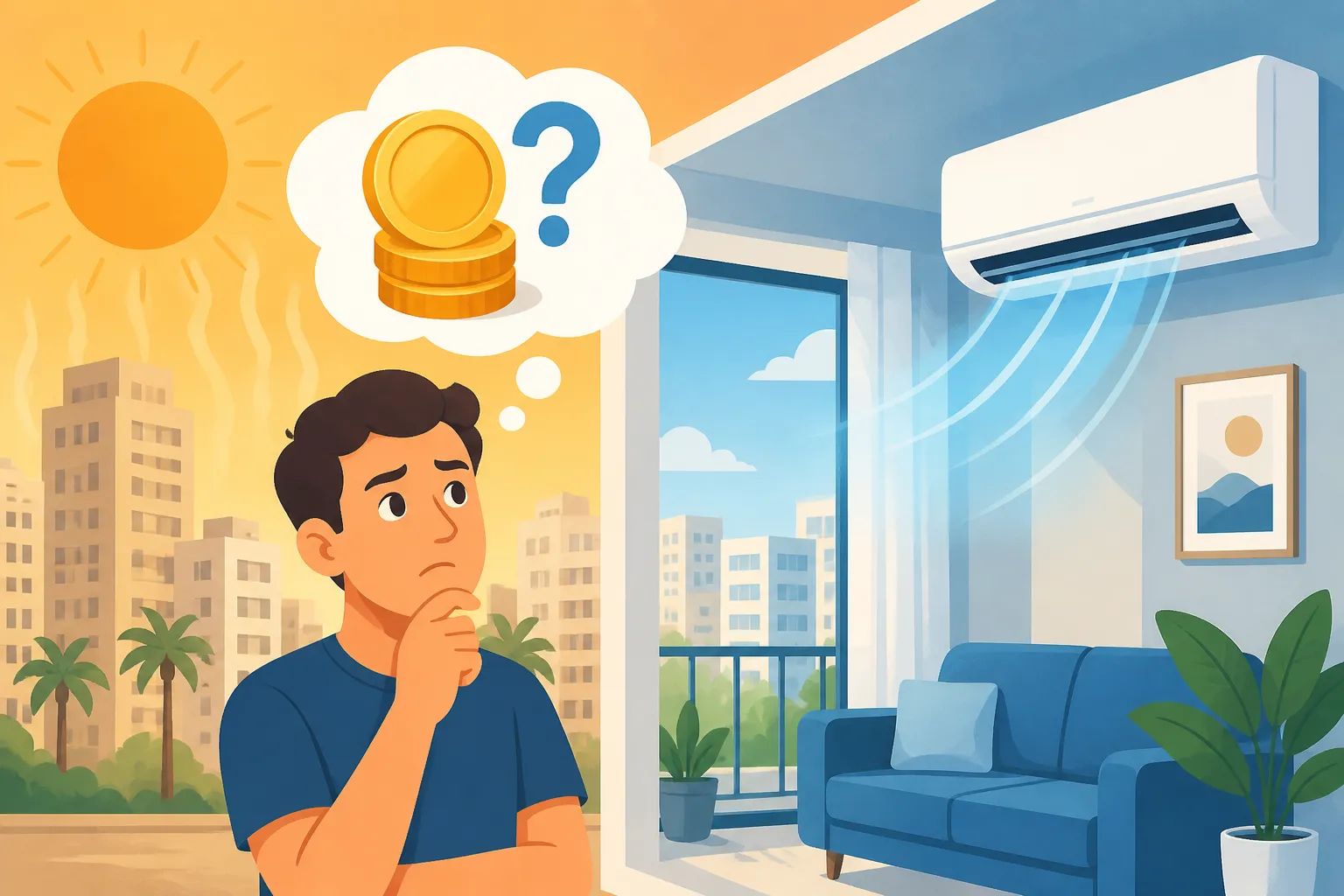
How Much Does It Cost to Cool an Apartment in Israel in Summer?
Oh, the Israeli summer! If you're new here, you're probably already feeling the intense heat and humidity, and maybe, just maybe, you've started to dread the arrival of your electricity bill. Trust me, you're not alone. Many of us expats have been there, staring at a shockingly high bill and wondering if we're doing something terribly wrong. This guide is here to shed some light on what it really costs to cool an apartment in Israel during the summer months and, more importantly, how you can keep those energy bills from giving you a heart attack.
The Unavoidable Reality: Israeli Summers and Air Conditioning
Let's get one thing straight: air conditioning in Israel during the summer isn't a luxury; it's a necessity. We're talking about temperatures that often soar into the high 30s Celsius (that's pushing 100°F for my American friends), combined with a humidity level along the coast that makes you feel like you're swimming through the air. You simply cannot survive comfortably, let alone sleep, without a functioning AC unit for a significant portion of the year. Forget about just "toughing it out" – your sanity, and perhaps your health, depend on it.
Why Air Conditioning is a Must, Not a Luxury, Here
Anyone who's experienced a full Israeli summer knows the feeling. You step outside, and it's like walking into a warm, wet blanket. Inside, if your apartment isn't properly cooled, the heat can become unbearable. From June through September, and often stretching into October, daytime temperatures rarely dip below 30°C. And then there are the infamous sharav days, which are heatwaves often accompanied by dry, desert winds, making the air feel like an oven. During these times, even the locals, who are accustomed to the heat, crank up their AC to stay comfortable. You'll quickly realize that your entire social life, work productivity, and sleep quality are intrinsically linked to your ability to maintain a cool indoor environment.
The reality is, most Israeli apartments are designed with the assumption that you'll be using air conditioning. Unlike some countries where homes might have extensive passive cooling features or thick insulation, many older Israeli buildings, especially in cities like Tel Aviv or Jerusalem, can feel like concrete ovens without mechanical cooling. This leads directly to a higher reliance on AC, and consequently, higher electricity consumption. For new immigrants, understanding how to navigate the local utilities is just one of the many challenges you face. If you're just starting your journey here, our guide on The Complete Guide to Making Aliyah: Your First 90 Days in Israel (2027) might offer helpful insights on getting settled.
Key Factors that Drive Your Cooling Costs
Several elements play a significant role in how much you'll shell out to keep your apartment cool. It's not just about how hot it is outside. First and foremost, the size and layout of your apartment are critical. A small studio apartment will naturally cost less to cool than a sprawling three-bedroom family home. The number of rooms you're cooling simultaneously also matters. Secondly, insulation quality is huge. Older buildings in Israel often have minimal insulation, thin walls, and single-pane windows, allowing heat to seep in easily. Newer construction tends to be better, but it's not always a guarantee. If you're currently in the process of looking for an apartment, our guide on The Complete Guide to Renting an Apartment in Israel (2027) could offer some valuable tips on what to look for, including aspects that affect energy efficiency.
Third, window efficiency is tied to insulation. Are your windows double-glazed? Do they have good seals? Are they exposed to direct sunlight for most of the day? All these factors contribute to how effectively your AC can maintain a consistent temperature. Fourth, your personal comfort levels are a major driver. Do you like your apartment to feel like a refrigerator, or are you comfortable with a slightly warmer, more moderate temperature? Every degree you lower the thermostat below the recommended optimal setting can significantly increase your energy consumption. Finally, the age and type of your AC unit are paramount. Older, less efficient units work harder and consume more electricity to achieve the same cooling effect as newer, inverter-technology models. A well-maintained unit will also run more efficiently than one that hasn't seen a filter cleaning in years.
Decoding Your Electricity Bill: Chevrat HaChashmal and Consumption
The Israeli electricity company, known as Chevrat HaChashmal (sometimes also referred to as Israel Electric Corporation or IEC), is your primary source of power. Understanding how they bill you is the first step to making sense of those summer statements. It's a bimonthly bill for residential users, which means you'll get a statement every two months. This can sometimes lead to a "sticker shock" when a full two months of intense summer AC usage hits at once.
Understanding the Israeli Electricity Company (Chevrat HaChashmal) Charges
When you receive your bill from Chevrat HaChashmal, you'll see charges based on your consumption in kilowatt-hours (kWh). As of late 2023 and early 2024, the residential electricity tariff in Israel has seen some adjustments. While the exact price per kWh can fluctuate slightly based on approvals from the Electricity Authority, it's generally around NIS 0.60 to NIS 0.65 per kWh. There isn't a widely applied peak/off-peak rate system for standard residential consumers like you might find in some other countries, making it a fairly straightforward calculation of how many kWh you use multiplied by the tariff. However, there are usually fixed charges for infrastructure and service, regardless of your usage, which are a smaller component.
The critical thing to remember is that this rate adds up quickly when your AC is running for hours on end, day after day. A typical modern inverter AC unit for a medium-sized room (say, 1.5 HP) can consume anywhere from 0.8 to 1.5 kWh per hour, depending on how hard it's working. If you're running two such units for 10-12 hours a day, you can easily rack up 20-30 kWh daily, translating to several hundred shekels over a two-month period just for those units. It’s a lot to wrap your head around, especially when you're also figuring out other local services. Our guide on The Expat Guide to Setting Up Utilities in Israel provides more detailed information on setting up accounts for electricity, water, and gas.
How Your Habits Directly Impact Your Spending
Your personal habits are probably the biggest controllable factor in your electricity bill. Are you the type to leave the AC blasting while you pop out for a quick errand? Or perhaps you set the thermostat to a frosty 19°C (66°F) because you love that deep chill? Every degree lower than the optimal temperature (which is generally considered 24-25°C or 75-77°F for comfort and efficiency) increases energy consumption significantly. It's not uncommon for people to forget to close windows and doors while the AC is running, essentially cooling the entire neighborhood.
Another common scenario is having multiple AC units running simultaneously in different rooms, even if those rooms aren't occupied. This is particularly relevant in larger family apartments. It’s easy to get complacent, especially when the heat is oppressive, but these small inefficiencies add up dramatically over a two-month billing cycle. Thinking about ways to stay connected and productive while being mindful of expenses can be a balancing act. For instance, using a reliable local data plan or an international eSIM like Airalo can help you manage your smart home devices or simply stay in touch without worrying about roaming charges when you're out and about, especially if you're trying to monitor your home's temperature remotely.
The Role of Your AC Unit's Efficiency
Not all air conditioning units are created equal, and their efficiency rating plays a huge role in your summer bill. In Israel, you'll find everything from older, fixed-speed "on-off" models to modern inverter technology units. Inverter ACs are significantly more energy-efficient because they can modulate their compressor speed to maintain a consistent temperature, rather than constantly cycling on and off at full power. This results in much smoother operation and lower electricity consumption over time.
When considering an apartment, or if you're thinking about upgrading your current unit, look for its energy rating. These are usually labeled with a letter grade, with 'A' being the most efficient. A good inverter unit, properly sized for the room it's cooling, can save you hundreds, if not thousands, of shekels over an inefficient, oversized, or undersized older model. While getting familiar with these local nuances, it's worth checking out comprehensive resources like Navigating the Israeli Healthcare System: An Expat's Roadmap (2027) or The Complete Guide to Working in Israel as a Foreigner (2027) to help with other aspects of settling in and making financially sound decisions.
Smart Strategies to Keep Your Apartment Cool and Your Bill Down
Okay, so we've established that AC is essential, and it costs money. Now, let's talk about what you can actually do to mitigate those costs without sacrificing all your comfort. There are plenty of practical steps you can take, from simple habit changes to smarter home management.
Optimizing Your AC Usage for Cost Savings
This is where the rubber meets the road. The single most impactful thing you can do is adjust your AC habits. Firstly, aim for a comfortable yet sensible temperature. Most energy experts recommend setting your thermostat between 24°C (75°F) and 25°C (77°F) during the day. Believe it or not, your body adjusts, and you'll still feel cool without overworking your unit. At night, you might go a degree or two lower if needed for sleep, but avoid the deep freeze. Secondly, utilize timers! Many modern AC units have built-in timers. Set it to turn on an hour before you arrive home and turn off after you go to sleep, or even turn off completely an hour before you wake up – the residual cool air will often last.
Thirdly, focus on "spot cooling." Close off rooms you're not using. Don't try to cool your entire apartment if you're only spending time in the living room and bedroom. Keep internal doors closed to trap the cool air where you need it. Regular maintenance is also crucial. Clean your AC filters at least once a month during summer. Dirty filters restrict airflow, making your unit work harder and consume more electricity. If you're struggling to find reliable services, asking for recommendations from local expat groups can often point you in the right direction, much like finding the best bank for expats. Our guide on How to Choose the Best Bank for Expats in Israel can assist with that specific financial challenge.
Passive Cooling and Insulation Hacks
While you might not be able to remodel your rental apartment, there are still effective passive cooling strategies. Shading is your best friend. Keep blinds, curtains, or external trissim (roller shutters) closed during the hottest parts of the day, especially on windows that get direct sunlight. This prevents solar gain from heating your interior. The sun beating down on a window can heat a room surprisingly quickly, so block it out! If your apartment has an outdoor space, consider adding temporary shade sails or awnings, if permitted.
Check for drafts around windows and doors. Even small gaps can allow hot air to infiltrate. Use weatherstripping or door snakes to seal them up. Minimizing heat-generating appliances during peak heat hours is also a smart move. Try to run your washing machine, dishwasher, or oven in the early morning or late evening when the outside temperature is lower and electricity demand might be less (though, as mentioned, residential tariffs are mostly flat). Every little bit helps to keep the internal heat load down, reducing the strain on your AC. Moving to a new place can involve a lot of logistics, and services like Sirelo can simplify the relocation process, ensuring you have more time to focus on these important details for your new home.
Supplementary Cooling and Modern Solutions
Don't underestimate the power of a good fan! Ceiling fans and standing fans don't cool the air, but they create a wind-chill effect that makes you feel cooler, allowing you to set your AC thermostat a degree or two higher without feeling uncomfortable. This alone can lead to significant savings. Combine a fan with your AC, and you'll find a surprising difference.
For those tech-savvy expats, a smart thermostat can be a game-changer. Devices like Google Nest or Ecobee, if compatible with your Israeli AC system (which isn't always a given, so check compatibility carefully), can learn your habits, optimize schedules, and even integrate with your phone so you can control your AC remotely. Imagine turning on the AC on your way home from work, so you walk into a perfectly cool apartment without having had it running all day. However, setting up home internet is one of those crucial first steps, as covered in How to Set Up Home Internet and TV in Israel. Having reliable internet is also key for these smart home solutions.
What to Budget: Real-World Cooling Cost Estimates
Now for the numbers. It's tough to give exact figures because of all the variables we've discussed, but I can offer some realistic estimates based on typical expat experiences here in Israel. These are for a two-month billing cycle during the peak summer months (July-August). Remember, you get a bill every two months, so you'll pay this amount after two months of usage.
Typical Monthly Costs Across Different Apartment Sizes
Let's break it down by apartment size and usage level. These are electricity costs for cooling only, not your entire electricity bill, which would also include lighting, water heater, refrigerator, etc.
| Apartment Size | Light Usage (e.g., nights only, higher temp) | Medium Usage (e.g., 8-10 hours/day, 24-25°C) | Heavy Usage (e.g., 12+ hours/day, <23°C) |
|---|---|---|---|
| Studio / 1-Room | NIS 150 – 250 | NIS 250 – 400 | NIS 400 – 600+ |
| 2-3 Room Apartment | NIS 250 – 450 | NIS 450 – 750 | NIS 750 – 1100+ |
| Larger Family Home | NIS 400 – 700 | NIS 700 – 1200+ | NIS 1200 – 1800+ |
Note: These are estimates for peak summer months (e.g., July-August electricity bill covering June-July consumption) and are subject to variations in electricity tariffs, specific AC unit efficiency, and individual apartment characteristics.
As you can see, the range is quite wide. A small, well-insulated studio with an efficient inverter AC and smart usage could get by with NIS 200-300 per month for cooling. A larger, older apartment with multiple older AC units running constantly could easily push into the NIS 1,000+ per month category for cooling alone. When you factor in other utilities and general living expenses, these costs become a significant part of your The Complete Guide to Cost of Living in Israel for Expats (2026).
Preparing for the Heatwave Surge and Unexpected Bills
Israeli summers aren't uniformly hot. There are periods of intense heatwaves, those sharav days, where the temperature simply refuses to drop, even at night. During these times, you'll naturally use your AC more heavily, and your units will have to work harder. This can lead to unexpected spikes in your bill. It's not uncommon for a "medium user" in a 2-3 room apartment to suddenly find themselves in the "heavy usage" category during a prolonged heatwave.
My advice? Always budget a little extra for utilities during the summer months. Don't be caught off guard. It's better to have a buffer than to be scrambling when a higher-than-expected bill arrives. You might even consider setting aside a small amount each month specifically for this. This proactive approach to financial management is a skill you'll develop living in Israel, much like learning How Bituach Leumi Health Contributions Work in Israel or filing your annual taxes, as detailed in Filing Your Annual Tax Report in Israel: The Complete Walkthrough (2027). Being prepared helps alleviate the stress of living in a new country.
Disclaimer
The information provided in this guide is for general informational purposes only and does not constitute professional advice. While we strive to provide accurate and up-to-date information, circumstances can change. We recommend consulting with local experts or relevant authorities for specific advice regarding your personal situation.